Welcome & Introduction

FAIR & Reproducible Teaching with Quarto & Git
Course at University of Hamburg
Slides | Source

License: CC BY 4.0

09:30

1 Logistics & Admin

About

Me

📈 Now: Senior Specialist for Data & AI in the public sector at PD - Berater der Öffentlichen Hand

🧑‍🔬 Before: Postdoctoral Researcher at the Institute of Psychology at the University of Hamburg

🎓 Education: BSc Psychology & MSc Cognitive Neuroscience (TU Dresden), PhD Cognitive Neuroscience (MPIB)

🔬 Research: I studied the role of fast neural memory reactivation (“replay”) in the human brain using fMRI

🔗 Contact: You can connect with me via email, BlueSky, Mastodon, GitHub or LinkedIn

ℹ️ Info: Find out more about my work on my website, Google Scholar and ORCiD

This course

💻 Materials: All materials are available at https://lennartwittkuhn.com/fair-teaching-course/

📦 Software: Reproducible materials are built with Quarto and deployed to GitHub Pages using GitHub Actions

Source: Code is available on GitHub at https://github.com/lnnrtwttkhn/fair-teaching-course/

🙏 Contact: I am happy for any feedback or suggestions via email or GitHub issues. Thank you!

Who are you?

  1. Your name?
  2. Your preferred pronouns?
  3. Your research?
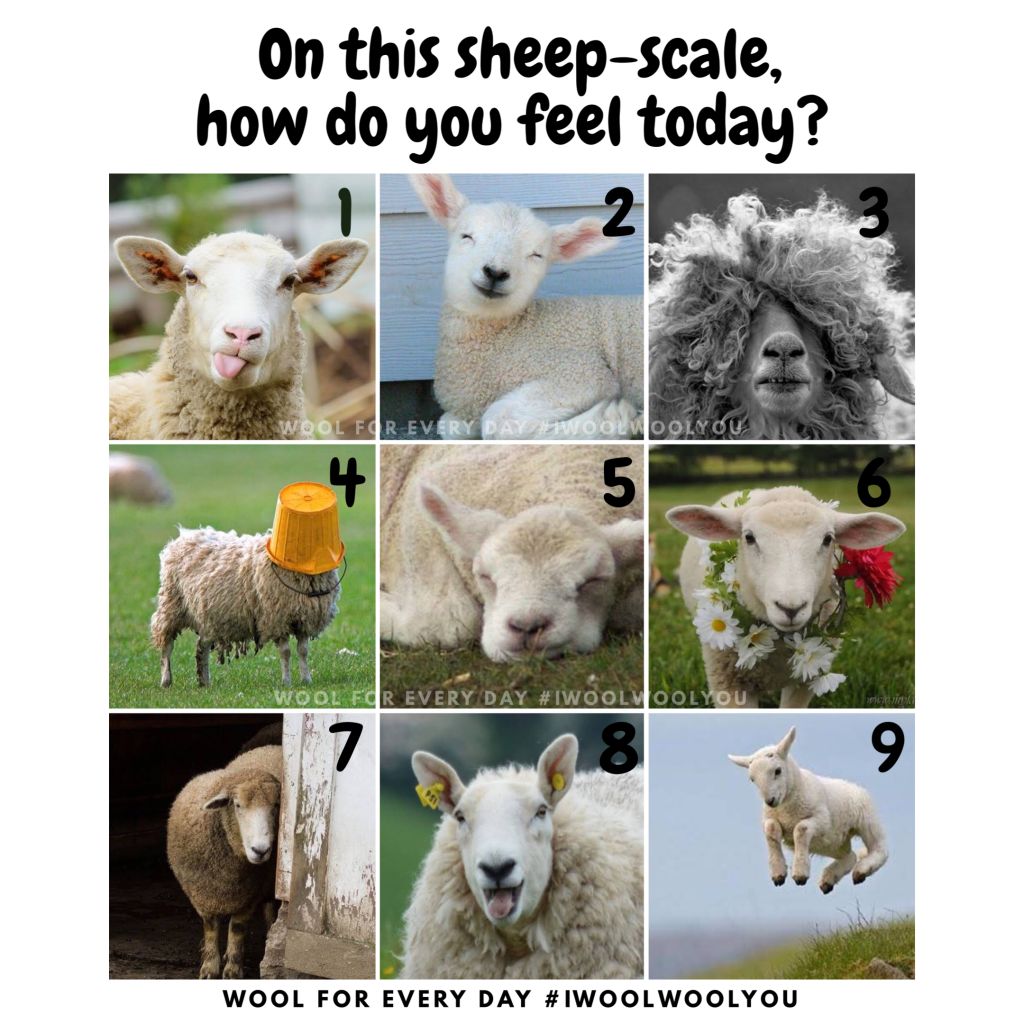
  4. Your mood on a sheep scale?

Mood on a sheep scale.

Course overview

  • Date: Friday, March 20th 2026
  • Time: 9:30 to 16:30
  • Room: VPM5, Room 4047

What will the average session look like?

Each day consists of 6 main sessions (ca. up to 60 minutes each)

  1. Demonstration (up to 15 minutes):
    The instructor introduces the topic and gives a short demonstration of the main tools and practices.
  1. Exercises (up to 30 minutes):
    Course participants work on hands-on exercises and assignments.
  1. Discussions (up to 15 minutes):
    Course participants and instructor collectively address any questions related to the session’s content.

This is a workshop.

Experiment!

Ask questions!

Discuss!

Schedule

Day 1

Day Date Time Title
1 2026-03-20 09:30 - 10:00 Welcome & Introduction
1 2026-03-20 10:00 - 10:30 Quarto: Introduction
1 2026-03-20 10:30 - 10:45 Quarto: Presentations
1 2026-03-20 10:45 - 11:00 Git: Setup & Configuration
1 2026-03-20 11:00 - 11:15 Command Line
1 2026-03-20 11:15 - 12:00 Git: Basics
1 2026-03-20 12:00 - 13:00 Lunch Break
1 2026-03-20 13:00 - 14:00 Git: Remotes
1 2026-03-20 14:00 - 15:00 Git: Collaboration
1 2026-03-20 15:00 - 15:30 Quarto: Publication to GitHub Pages
1 2026-03-20 15:30 - 16:00 Git: Tags & Releases

Course website

https://lennartwittkuhn.com/fair-teaching-course/

Pair Programming (variant)

  • Find and say hello to your nearest desk neighbor
  • Complete the exercises together, help each other out, etc.
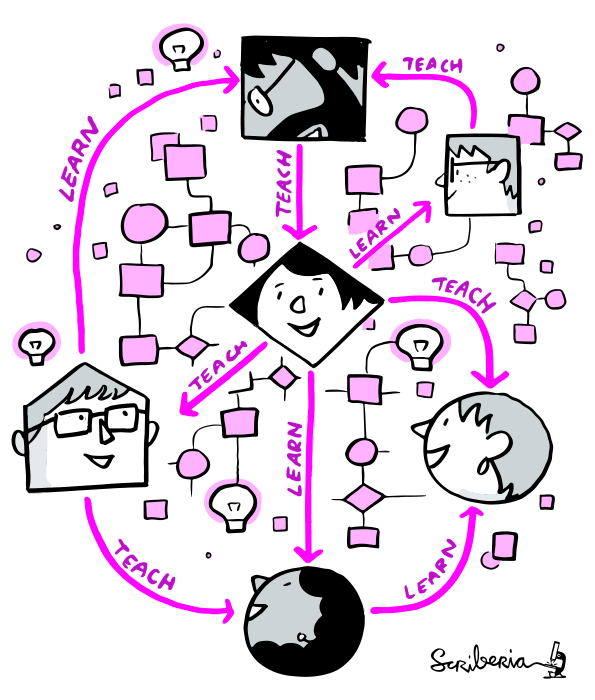
This illustration is created by Scriberia with The Turing Way community. Used under a CC-BY 4.0 licence. DOI: 10.5281/zenodo.3332807

Let’s do the splits

Code of Conduct

During this course, we want to ensure a safe, productive, and welcoming environment for everyone who attends. All participants and speakers are expected to abide by this code of conduct. We do not tolerate any form of discrimination or harassment in any form or by any means. If you experience harassment or hear of any incidents of unacceptable behavior, please reach out to the course instructor, Dr. Lennart Wittkuhn (lennart.wittkuhn@tutanota.com), so that we can take the appropriate action.

Unacceptable behavior is defined as:

  • Harassment, intimidation, or discrimination in any form, verbal abuse of any attendee, speaker, or other person. Examples include, but are not limited to, verbal comments related to gender, sexual orientation, disability, physical appearance, body size, race, religion, national origin, inappropriate use of nudity and/or sexual images in public spaces or in presentations, or threatening or stalking.
  • Disruption of presentations throughout the course. We ask all participants to comply to the instructions of the speaker with regard to dedicated discussion space and time.
  • Participants should not take pictures of any activity in the course room without asking all involved participants for consent and receiving this consent.

A first violation of this code of conduct will result in a warning, and subsequent violations by the same person can result in the immediate removal from the course without further warning. The organizers also reserve the right to prohibit attendance of excluded participants from similar future workshops, courses or meetings they organize.

Breaks

  • We will have a one-hour lunch break.
  • Feel free to take short breaks in-between sessions (~ last 5 minutes) when needed.

Your survey responses

Thank you for your participation! 🙏

2 This session: Welcome & Introduction

Objectives

💡 You know what reproducibility is.
💡 You can argue why reproducibility is essential for research.
💡 You know what version control is.
💡 You can argue why version control is useful (for research).
💡 You can explain the difference between Git and GitHub.
💡 You understand the relevance of creating teaching materials in accordance with FAIR principles.
💡 You can develop reproducible teaching materials collaboratively using tools like Quarto and Git(Hub).

Reading

https://lennartwittkuhn.com/version-control-book/chapters/intro-version-control.html

Tasks

In this session, you will work on the following tasks:

  1. Reading: Read the chapter(s) https://lennartwittkuhn.com/version-control-book/chapters/intro-version-control.html in the Version Control Book.
  2. Implementation: Try out the commands in the chapter.
  3. Exercises: Work on the exercises.

As always:

  1. Try out the commands of this session and play around with them.
  2. Check whether you have achieved the learning objectives.
  3. Ask questions!

3 Introduction to FAIR

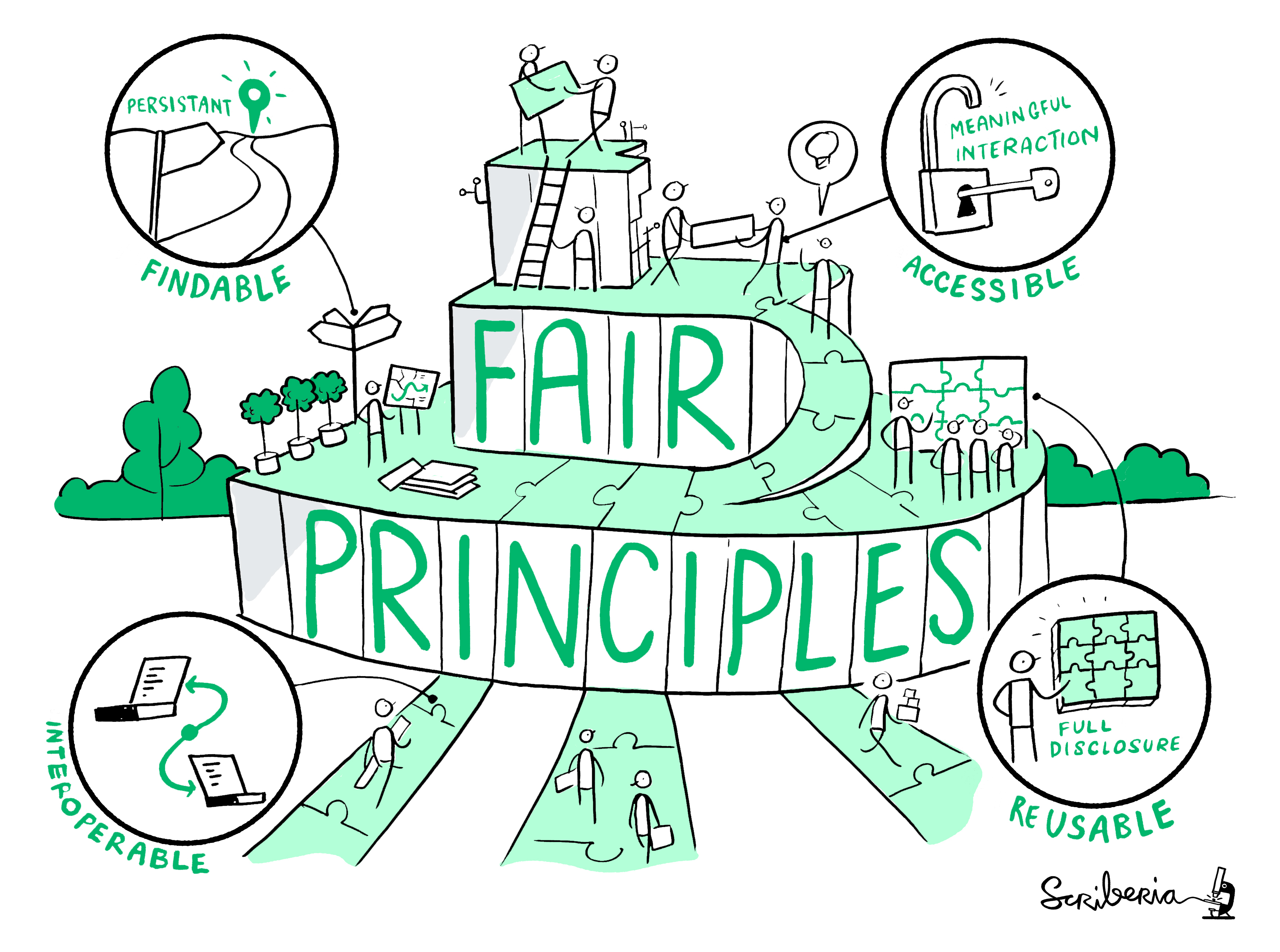
FAIR principles

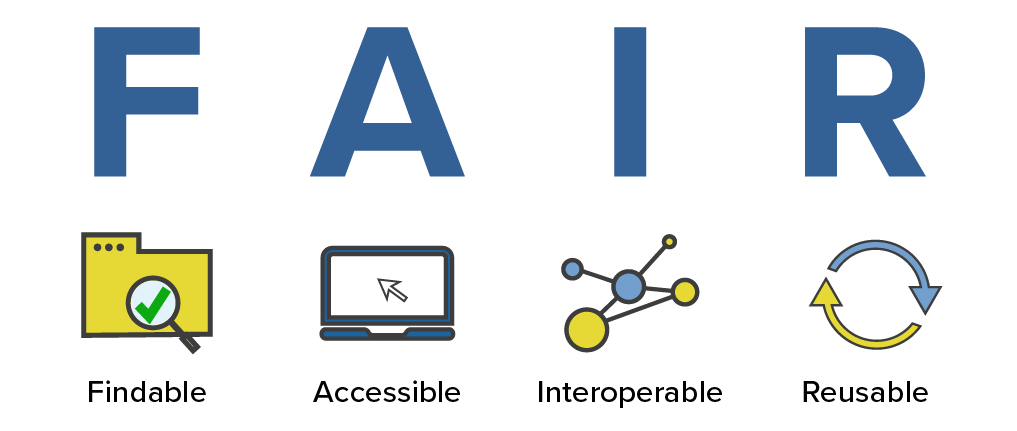
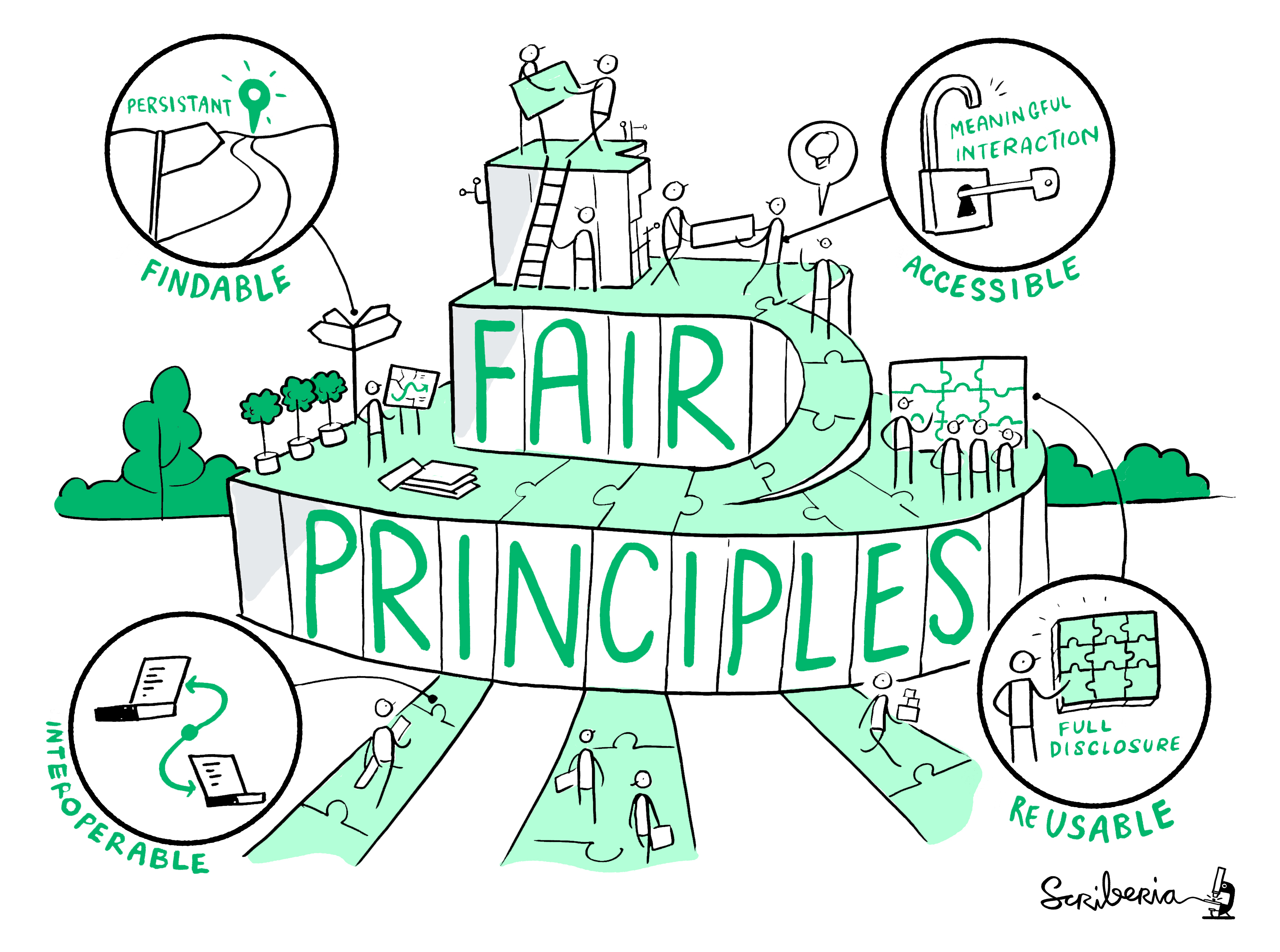
FAIR stands for Findable, Accessible, Interoperable, and Reusable (Wilkinson et al., 2016)

FAIR principles in detail

Findable

  • The first step in (re)using data is to find it!
  • Descriptive metadata is essential (data about data)
  • Use of persistent identifiers (e.g., DOIs)

Accessible

  • Once the user finds the data, they need to know how to access it.
  • Data could be openly available but authentication procedures may be necessary.

Interoperable

  • Data needs to be integrated with other data and interoperate with applications or workflows.

Reusable

  • Data should be well-described so that they can be used, combined, and extended in different settings.
  • Documentation and licenses

Planning for FAIR data

Start early

  • It is much easier to make data FAIR if you plan from the beginning of your (research) project
  • Plan for this in your Data Management Plan (DMP)
  • Consider FAIR principles when designing your study

Machine-readable benefits

  • The FAIR principles emphasize the importance of machine-readability to find, access, and reuse data with minimal human intervention
  • Essential in today’s data-driven era

FAIR ≠ Open

  • Making data ‘FAIR’ is not the same as making it ‘open’
  • Accessible means there is a procedure in place to access the data
  • Data should be as open as possible, and as closed as necessary

Aspirational principles

  • FAIR principles are aspirational: they describe a continuum of features
  • They do not strictly define how to achieve FAIRness
  • Think of them as guidelines, not requirements

FAIR principles beyond data

FAIR software

  • FAIR principles also apply to software and code
  • Research software should be findable, accessible, interoperable, and reusable
  • Version control, documentation, and open licenses

Environmental sustainability

  • FAIR practices can result in efficient code implementations
  • Reduce the need to retrain models
  • Reduce unnecessary data generation/storage
  • Lower carbon footprint through better practices

Accessibility considerations

  • “Accessible” in FAIR ≠ accessibility for all users
  • “Actually accessible” data is easy to locate, obtain, and use for everyone
  • Consider diverse user needs in your data sharing

Community efforts

FAIR Teaching Materials

Teaching materials can be considered as similar/equal to other research outputs. FAIR principles also apply!

Findable/Accessible

Interoperable

  • Use commonly used formats (PowerPoint) or open formats such as Markdown documents (see Quarto)
    • PDF is open but difficult to reuse!
  • Integrate with other resources where possible
    • Citations
    • Reuse of slides

Reusable

  • Add documentation (e.g., information sheets)
  • Add metadata (e.g., learning objectives, required resources, structure)
  • Share under an open license such as CC BY 4.0

Ten simple rules for making training materials FAIR

https://doi.org/10.1371/journal.pcbi.1007854

4 Introduction to reproducibility

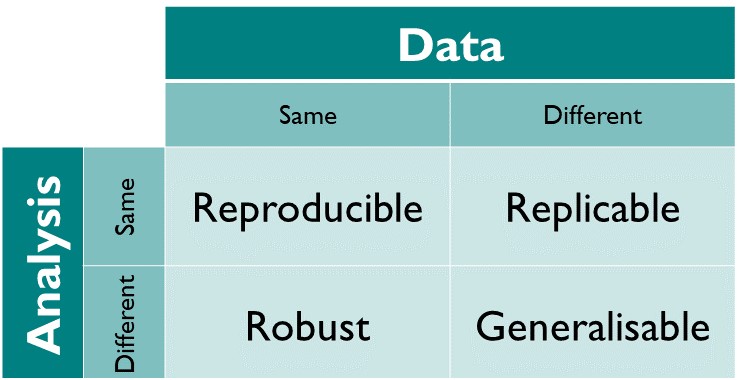
Definition of reproducibility

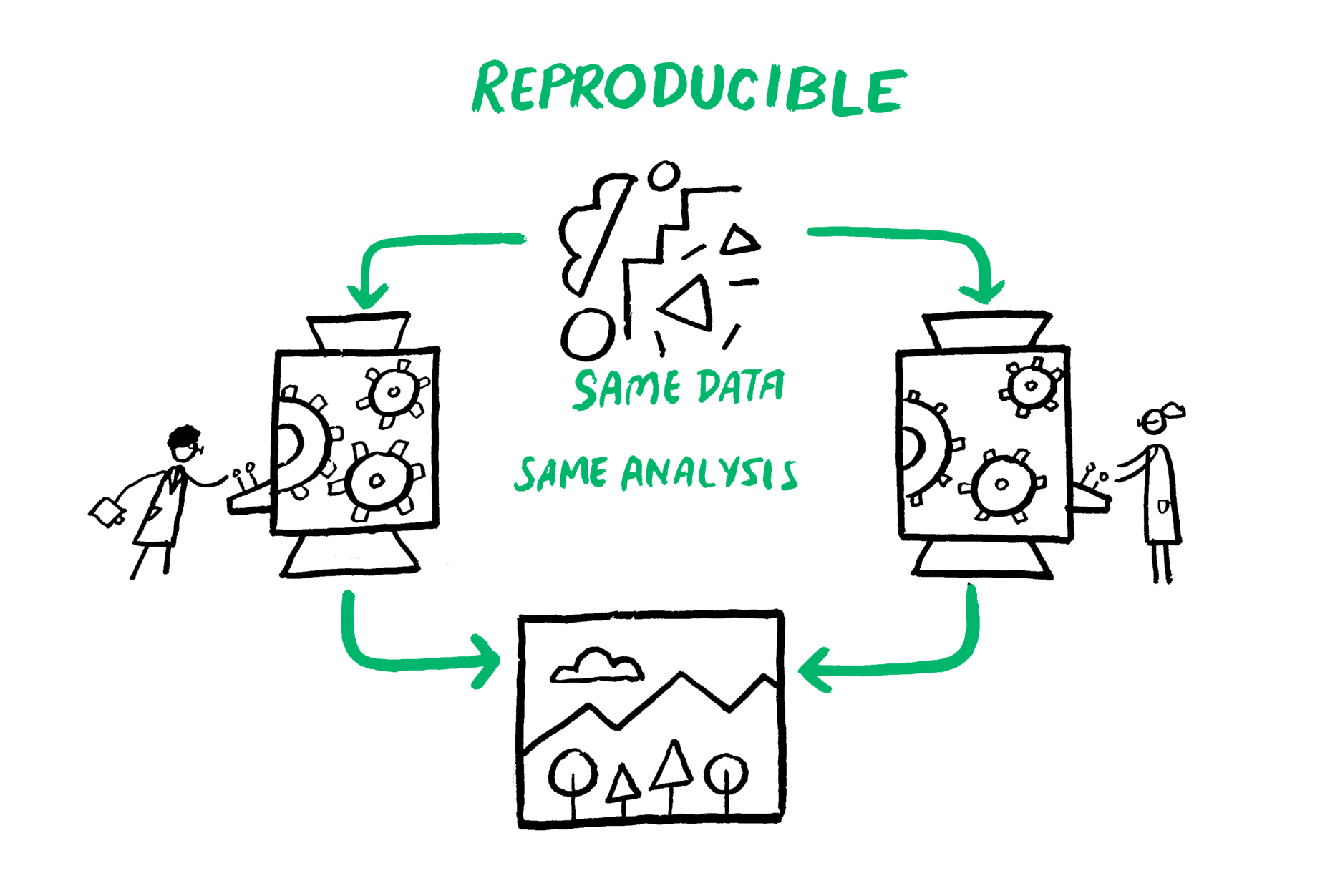
Research is reproducible …

“… when the same analysis steps performed on the same dataset consistently produce the same answer.” 1

by Scriberia for The Turing Way Community (2022) (Link, CC BY 4.0)

by Scriberia for The Turing Way Community (2022) (Link, CC BY 4.0)
  • In short: Someone else can run your analysis on their computer and gets the same results
  • Reproducibility as a minimal requirement for research?
  • This course: Focus on computational reproducibility

Current state of reproducibility in (psychological) research

Artner et al. (2021)

  • Analyzed 46 articles from three APA journals in 2012.
  • Extracted 232 statistical claims from these papers.
  • Successfully reproduced 163 statistical results (70%).
  • Focus: Reproducibility of individual statistical claims.

Hardwicke et al. (2021)

  • Analyzed 25 articles published in Psychological Science (2014–2015) with Open Data Badges.
  • 15 articles (60%) were fully reproducible.
  • 9 out of these 15 (60%) were reproducible without author involvement.
  • Focus: Study-level reproducibility.

Crüwell et al. (2023)

  • Investigated 14 articles from a more recent issue of Psychological Science.
  • Only 1 out of 14 articles was exactly reproducible.
  • 3 additional articles were essentially reproducible with minor deviations.
  • All articles had Open Data Badges.

Obels et al. (2020)

  • Analyzed 62 registered reports in Psychology (2014-18).
  • 36 reports (58%) shared both data and code.
  • Of those, 21 (58%) were found to be reproducible.
  • Focus: Impact of open science practices on reproducibility.

The issue of computational reproducibility in science

“… when the same analysis steps performed on the same dataset consistently produce the same answer.” 2

by Scriberia for The Turing Way Community (2022) (Link, CC BY 4.0)

The problem

  • about more than half of research is not reproducible 3
    • research data, code, software & materials are often not available “upon reasonable [sic] request”
    • if resources are shared, they are often incomplete
  • 90% of researchers: “reproducibility crisis” (N = 1576) 4

Why?

  • computational reproducibility is hard
  • researchers lack training
  • incentives are not (yet) aligned 5
  • more …

… accumulated evidence indicates […] substantial room for improvement with regard to research practices to maximize the efficiency of the research community’s use of the public’s financial investment.(Munafò et al., 2017)

We need a professional toolkit for digital research!

5 Introduction to Quarto

About Quarto

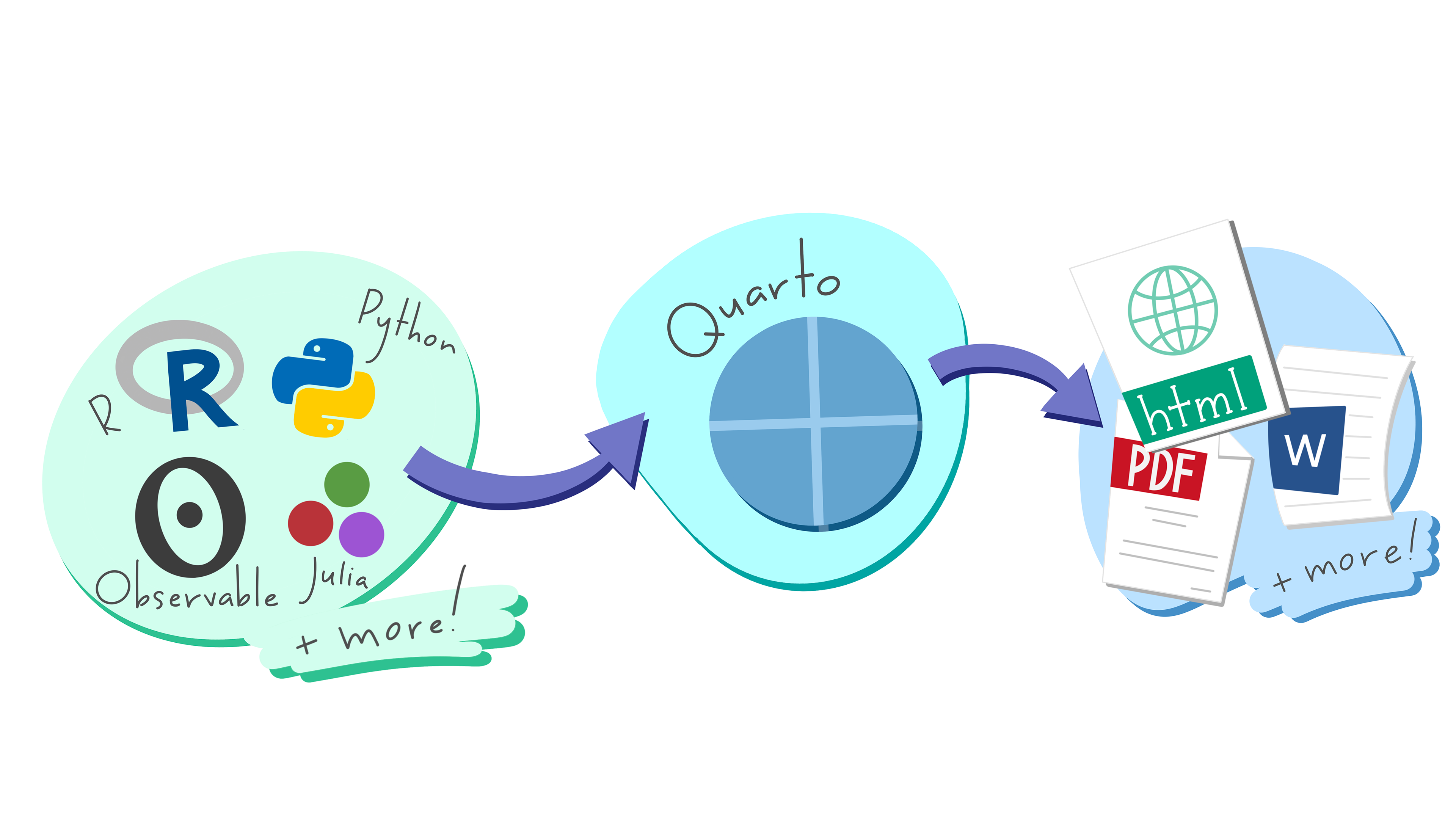
  • Quarto is a newish, open-source, scientific and technical publishing system
  • Publish reproducible presentations, websites, blogs, and books in HTML, PDF, MS Word, ePub, etc.
  • Consistent implementation of features across outputs: tabsets, code-folding, syntax highlighting, etc.
  • Beginner-friendly with helpful guardrails for new learners, incl. YAML completion, informative syntax errors, etc.
  • Multi-language support for R, Python, Julia, Observable and more functions via Jupyter
  • Quarto extends RMarkdown and shares similarities with Juypter Notebooks.
  • Support and community

6 Introduction to Version Control

Scenario 1

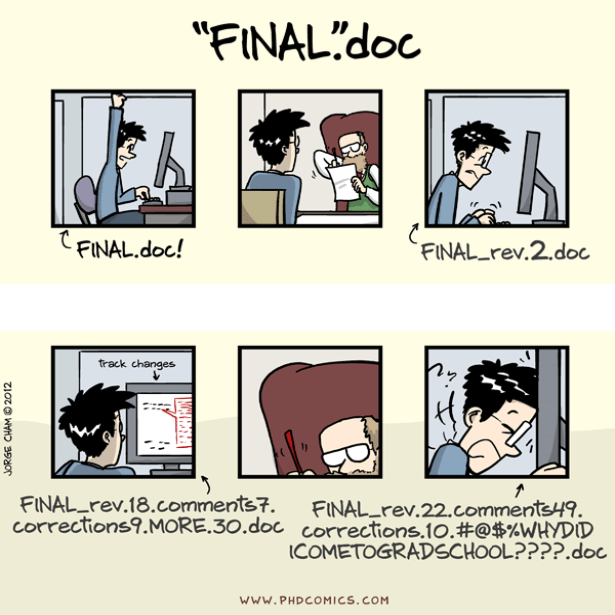
Imagine a scenario where you crafted a brilliant paragraph for a manuscript (for example, your paper, thesis, or report), but then accidentally ruined it. How would you retrieve the earlier brilliant version? Is it even possible?

  • “Only if I saved it before - otherwise, I’d have to draft another brilliant paragraph.”
  • “I might be able to find it in a cloud backup, like OneDrive or Google Drive.”
  • “Version Control?”
  • “I’d simply revert to the relevant commit.”

Scenario 2

Consider a situation where you are working with five co-authors on a paper. How do you handle the changes and comments they make to the document? If you’re using LibreOffice Writer or Microsoft Word and you accept changes made using the “Track Changes” option, what happens to the history of those modifications?

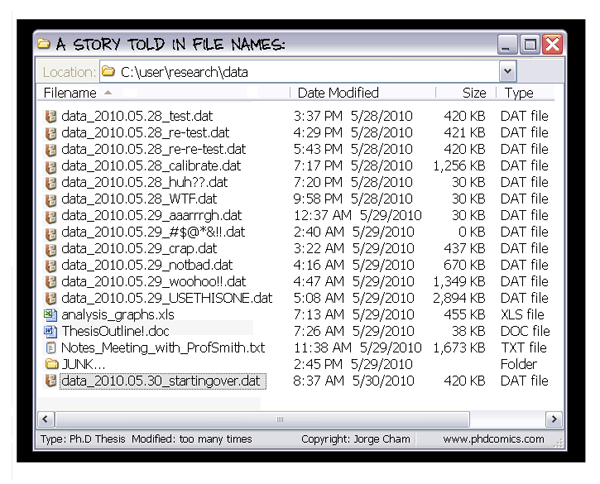
  • “I always save new versions of files with my initials (and others’ initials when I receive the document), which often results in having 10–20 different file versions.”
  • “I believe the history of modifications is lost after accepting the changes …”

Why we need version control …

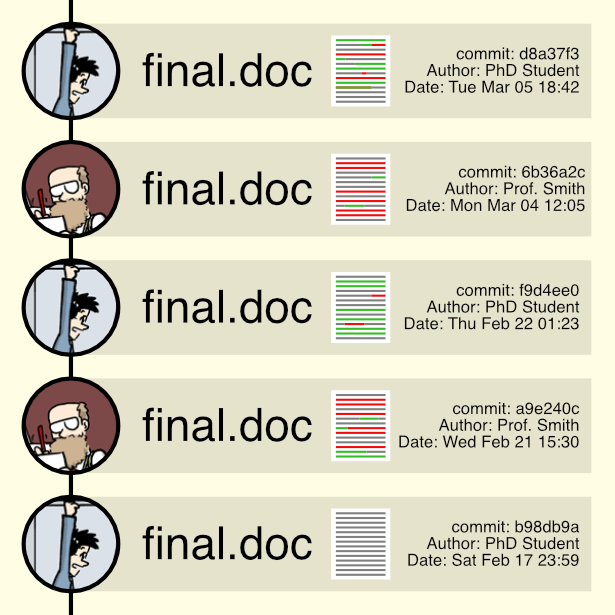
… for code (text files) © Jorge Cham (phdcomics.com)
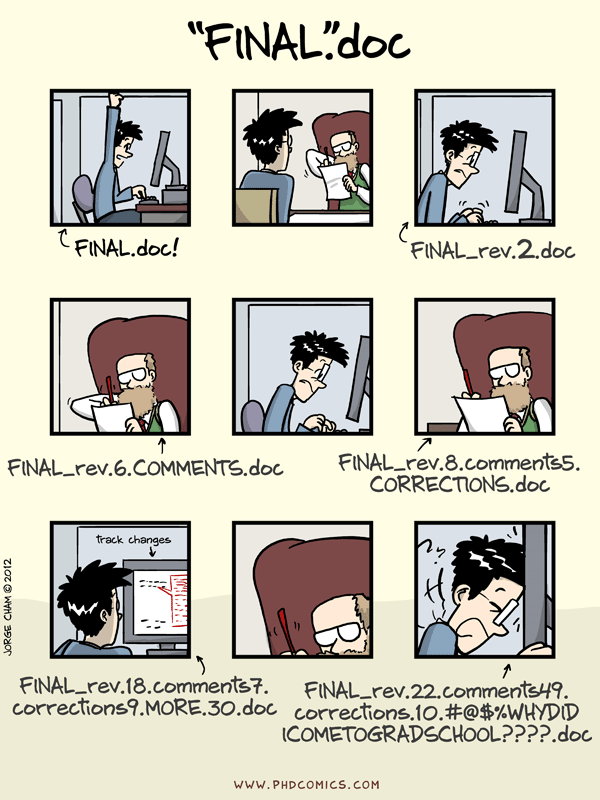
… for data (binary files) © Jorge Cham (phdcomics.com)

When everything is relevant …

… track everything.

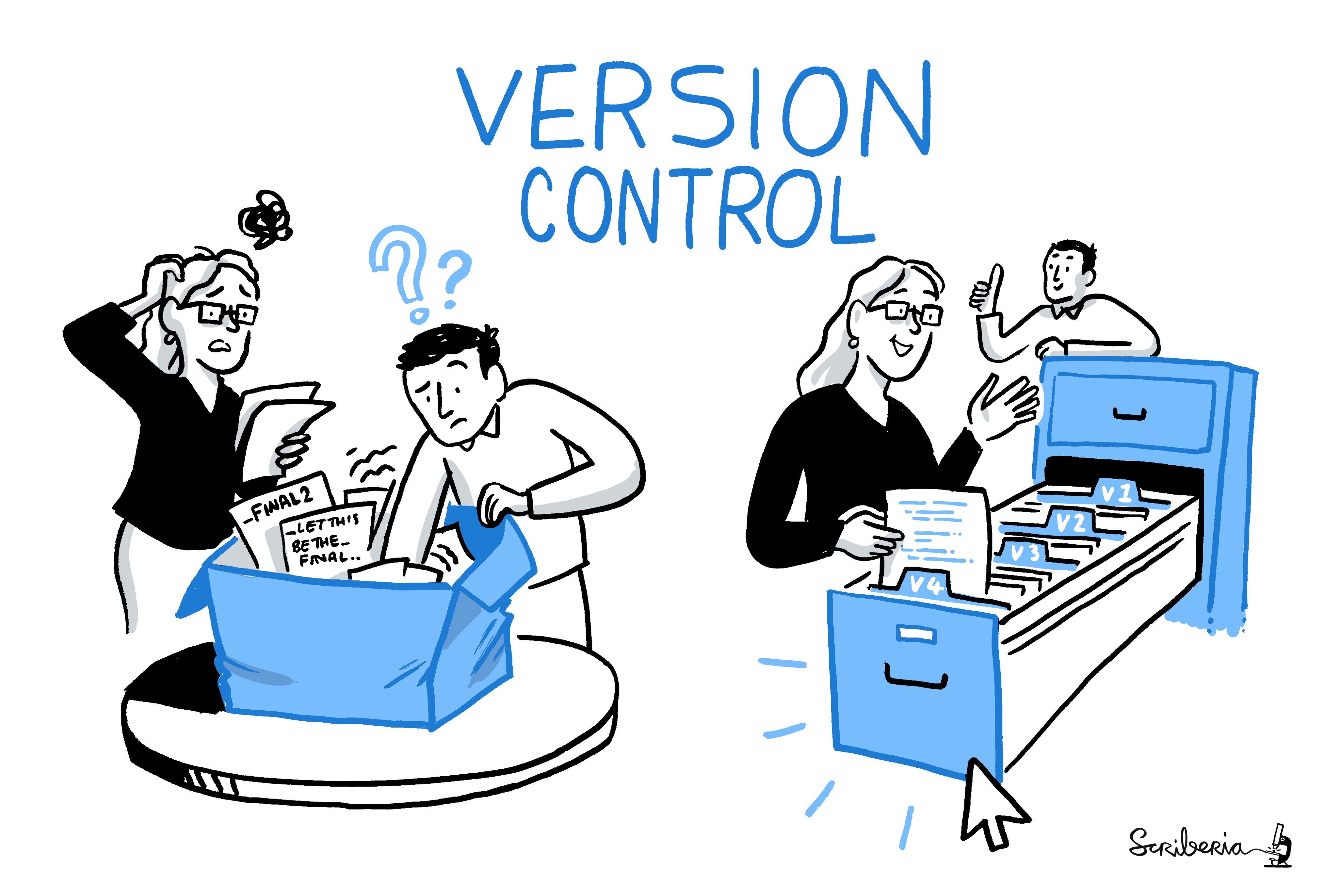
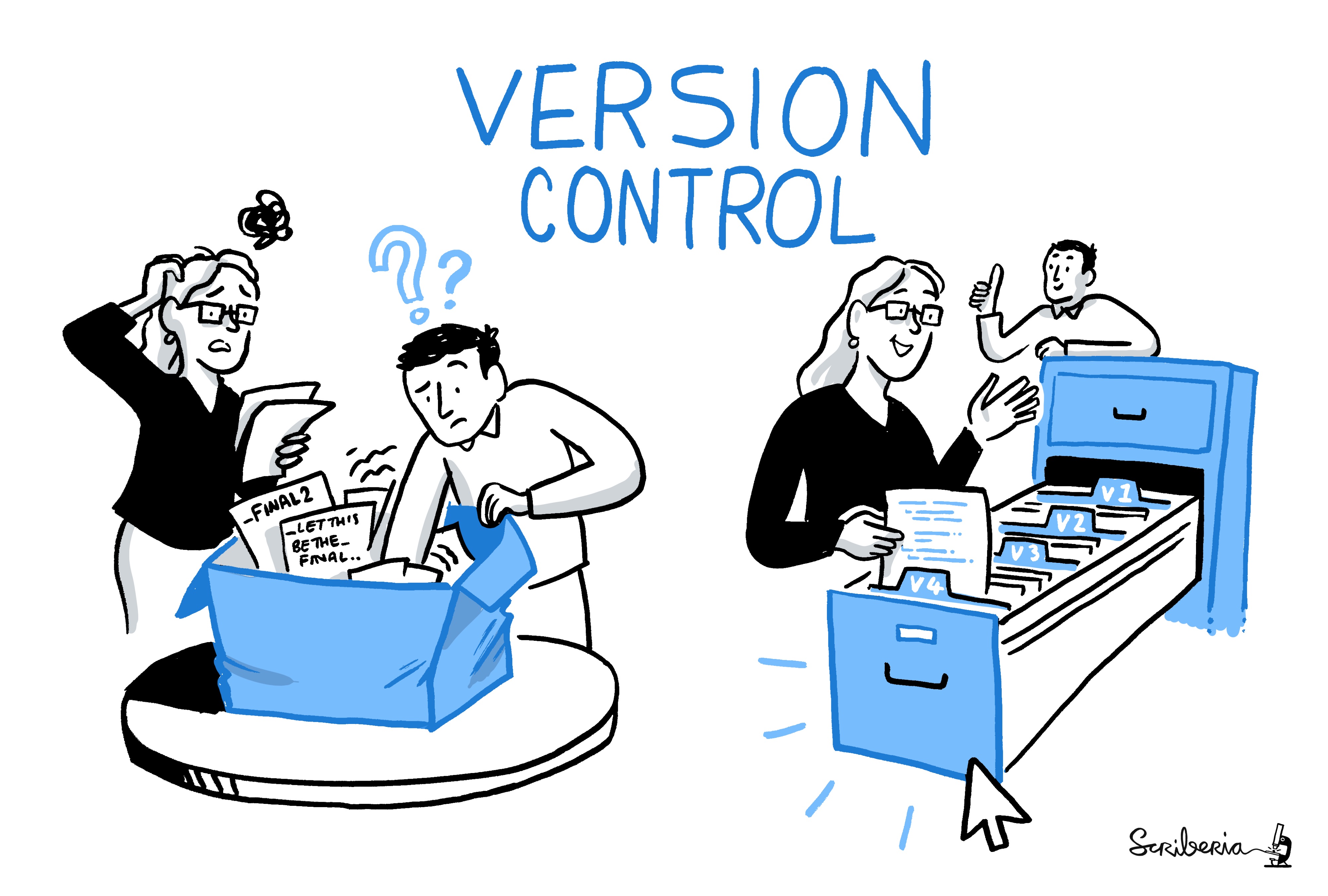
What is version control?

“Version control is a systematic approach to record changes made in a […] set of files, over time. This allows you and your collaborators to track the history, see what changed, and recall specific versions later […]” (Turing Way)

keep track of changes in a directory (a “repository”)

take snapshots (“commits”) of your repo at any time

know the history: what was changed when by whom

compare commits and go back to any previous state

work on parallel “branches” & flexibly “merge” them
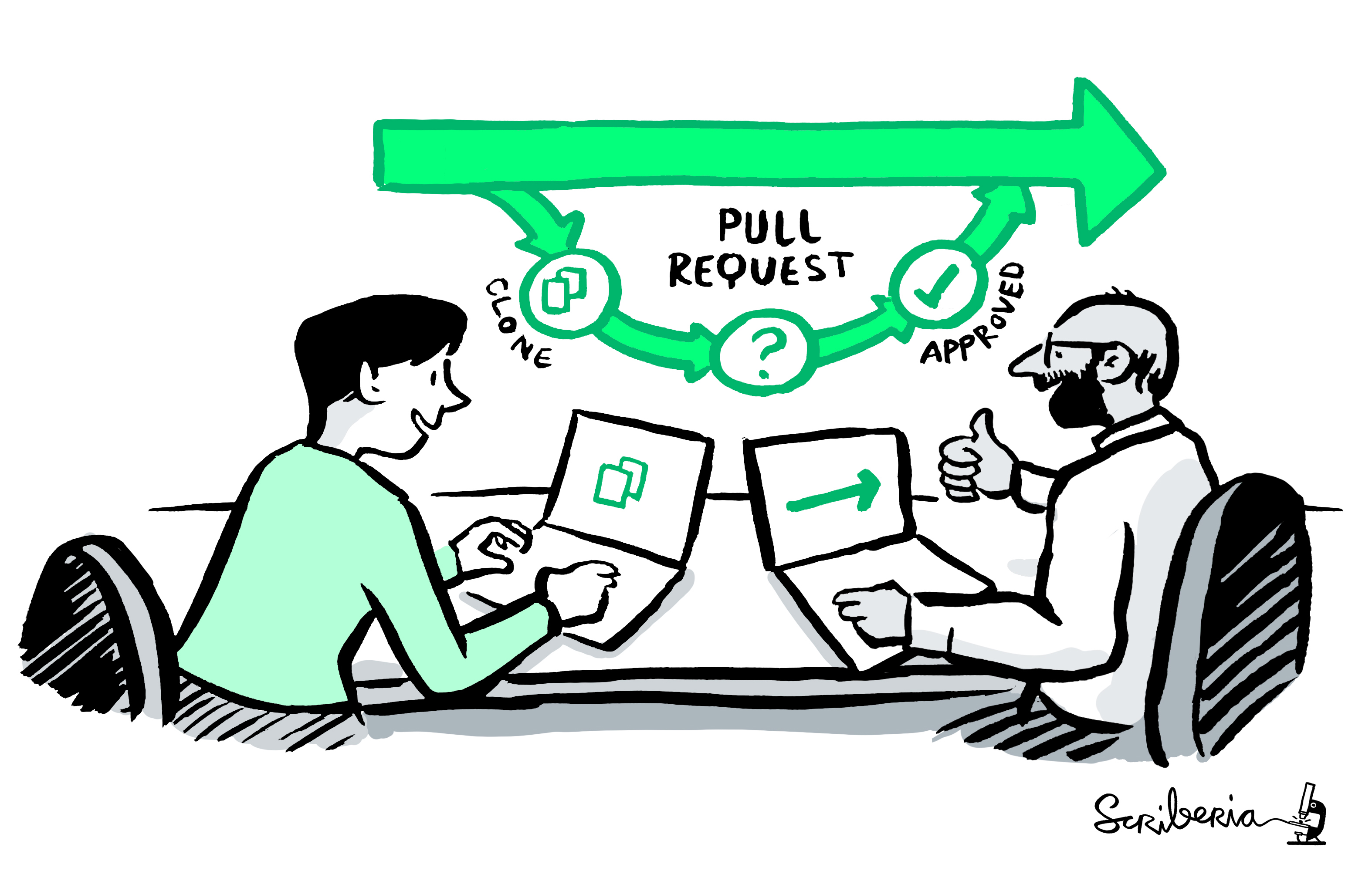
“push” your repo to a “remote” location & share it

share repos on platforms like GitHub or GitLab

work together on the same files at the same time

others can read, copy, edit and suggest changes

make your repo public and openly share your work
What is GitHub?
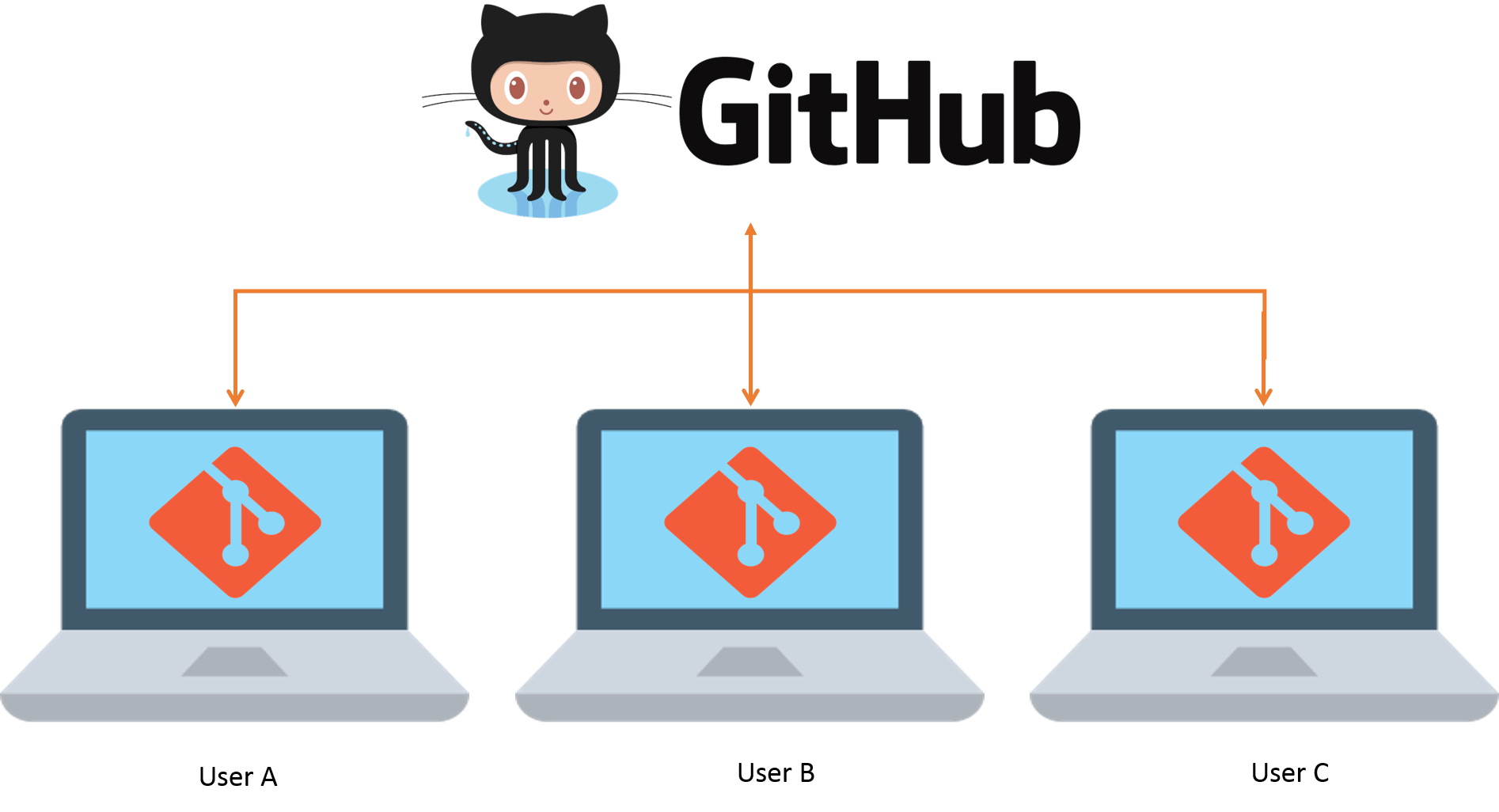
  • cloud-based platform for version control using Git
  • allows for collaboration on coding projects in real time
  • hosts millions of public and private repositories
  • supports both Git command line and GUI tools (e.g., GitHub Desktop)
  • enables code sharing, project management, issue tracking, and continuous integration
  • used by companies, open-source communities, and individual developers worldwide
  • 100 million users 6

More benefits of Git(Hub) for (teaching) project management

  • Discuss and plan your teaching preparation in issues (even just with your future / past self)
  • Ask questions, share ideas and discuss with your community via GitHub Discussions
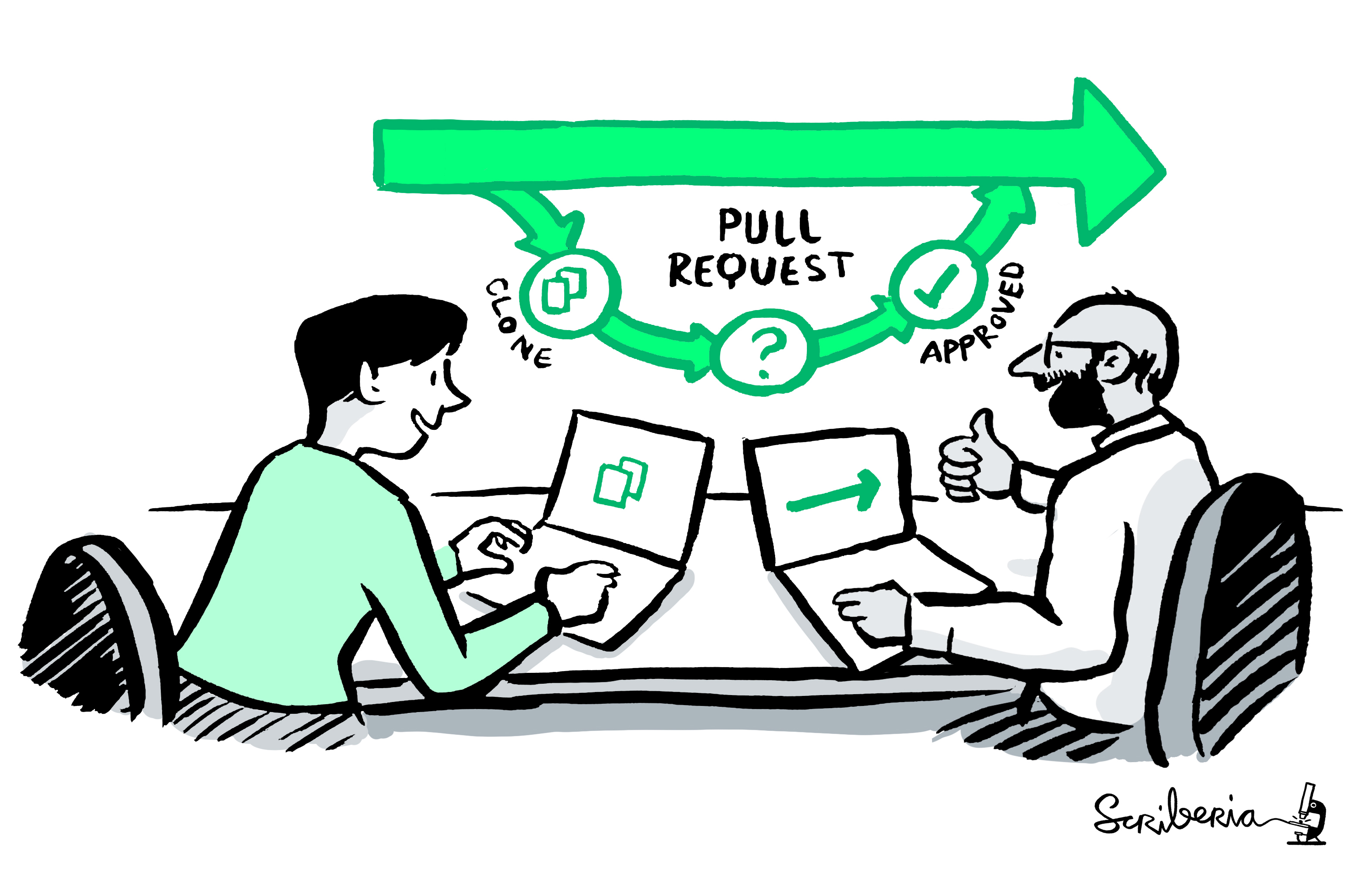
  • Propose changes to the teaching materials using pull requests 7
  • Create a fork of someone else’s repository and extend their teaching materials
  • Manage access to your teaching materials with detailed permissions and roles
  • Add documentation to your repository or in a separate wiki
  • Access to more features and tools for teaching via GitHub Campus Global

Note

  • The dominance of GitHub (a for-profit company owned by Microsoft) is not uncontested (see #GiveUpGitHub)
  • A project on GitHub is not a FAIR archiving of scholarly outputs (see previous and following slides)

Create a DOI for your teaching materials with Zenodo

Zenodo, a CERN service, is an open dependable home for the long-tail of science, enabling researchers to share and preserve any research outputs in any size, any format and from any science.” – from the Zenodo GitHub README

Integrate your teaching materials on GitHub with Zenodo

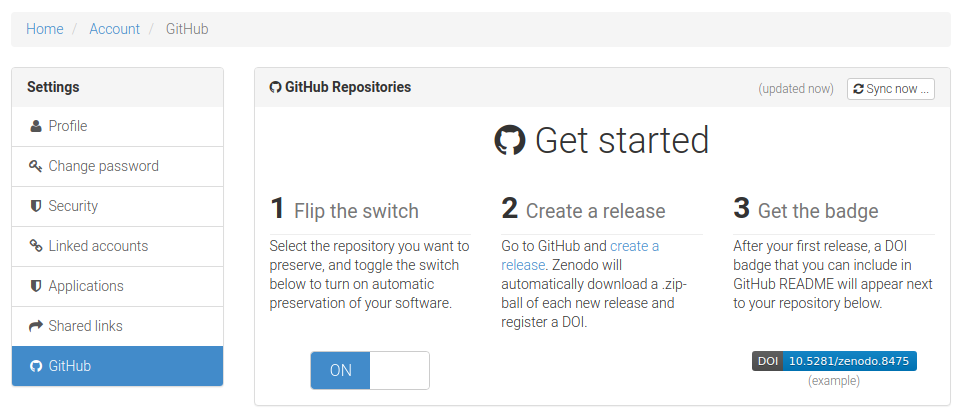
To make your repositories easier to reference in academic literature, you can create persistent identifiers, also known as Digital Object Identifiers (DOIs). You can use the data archiving tool Zenodo to archive a repository on GitHub.com and issue a DOI for the archive.” – Details in the GitHub documentation

  1. Navigate to the login page for Zenodo.
  2. Click Log in with GitHub.
  3. Review the information about access permissions, then click Authorize zenodo.
  4. Navigate to the Zenodo GitHub page.
  5. To the right of the name of the repository you want to archive, toggle the button to On.
Goal

From this …
To this …
7 Examples

Example: GitHub repository for these course materials

https://github.com/lnnrtwttkhn/fair-teaching-course/

Example: Collaborative workflow with issues and pull requests

github.com/lnnrtwttkhn/dra-fair-teaching/issues/1

Example: Research Data Management 101 Course at TU Delft Library (TNW RDM 101) (Example of a Quarto Book)

Summary: This course provides PhD candidates with the essential knowledge and the core skills to manage research data according to best practice.

estherplomp.github.io/TNW-RDM-101

Example: Course Website “Version Control of Code & Data” at the University of Hamburg (Example of a Quarto Website)

Summary: A hands-on seminar about version control of code and data using Git with curated online materials, interactive discussions, quizzes and exercises, targeted at (aspiring) researchers in Psychology & Neuroscience.

lennartwittkuhn.com/version-control-course-uhh-ws23

Version Control Book (Example for a Quarto Book)

lennartwittkuhn.com/version-control-book

8 Our goal

Creating FAIR, reproducible, version-controlled and collaborative teaching materials with Quarto and Git 🚀

9 Appendix

Resources

References

Artner, R., Verliefde, T., Steegen, S., Gomes, S., Traets, F., Tuerlinckx, F., & Vanpaemel, W. (2021). The reproducibility of statistical results in psychological research: An investigation using unpublished raw data. Psychological Methods, 26(5), 527–546. https://doi.org/10.1037/met0000365.
Baker, M. (2016). 1,500 scientists lift the lid on reproducibility. Nature, 533(7604), 452–454. https://doi.org/10.1038/533452a.
Crüwell, S., Apthorp, D., Baker, B. J., Colling, L., Elson, M., Geiger, S. J., Lobentanzer, S., Monéger, J., Patterson, A., Schwarzkopf, D. S., Zaneva, M., & Brown, N. J. L. (2023). Whats in a badge? A computational reproducibility investigation of the open data badge policy in one issue of Psychological Science. Psychological Science, 34(4), 512–522. https://doi.org/10.1177/09567976221140828.
Hardwicke, T. E., Bohn, M., MacDonald, K., Hembacher, E., Nuijten, M. B., Peloquin, B. N., deMayo, B. E., Long, B., Yoon, E. J., & Frank, M. C. (2021). Analytic reproducibility in articles receiving open data badges at the journal Psychological Science : An observational study. Royal Society Open Science, 8(1). https://doi.org/10.1098/rsos.201494.
Munafò, M. R., Nosek, B. A., Bishop, D. V. M., Button, K. S., Chambers, C. D., Percie du Sert, N., Simonsohn, U., Wagenmakers, E.-J., Ware, J. J., & Ioannidis, J. P. A. (2017). A manifesto for reproducible science. Nature Human Behaviour, 1(1). https://doi.org/10.1038/s41562-016-0021.
Obels, P., Lakens, D., Coles, N. A., Gottfried, J., & Green, S. A. (2020). Analysis of open data and computational reproducibility in registered reports in psychology. Advances in Methods and Practices in Psychological Science, 3(2), 229–237. https://doi.org/10.1177/2515245920918872.
Poldrack, R. A. (2019). The costs of reproducibility. Neuron, 101(1), 11–14. https://doi.org/10.1016/j.neuron.2018.11.030.
The Turing Way Community. (2022). The turing way: A handbook for reproducible, ethical and collaborative research. Zenodo. https://doi.org/10.5281/zenodo.3233853.
Wicherts, J. M., Borsboom, D., Kats, J., & Molenaar, D. (2006). The poor availability of psychological research data for reanalysis. American Psychologist, 61(7), 726–728. https://doi.org/10.1037/0003-066x.61.7.726.
Wilkinson, M. D., Dumontier, M., Aalbersberg, Ij. J., Appleton, G., Axton, M., Baak, A., Blomberg, N., Boiten, J.-W., Silva Santos, L. B. da, Bourne, P. E., Bouwman, J., Brookes, A. J., Clark, T., Crosas, M., Dillo, I., Dumon, O., Edmunds, S., Evelo, C. T., Finkers, R., … Mons, B. (2016). The FAIR guiding principles for scientific data management and stewardship. Scientific Data, 3(1). https://doi.org/10.1038/sdata.2016.18.

First Simple FAIR Checklist

Planning Phase (Findable + Reusable)

Active Research (Interoperable + Accessible)

Pre-Publication (All FAIR principles)

Publication (Findable + Accessible)

What about Open Science?

Open science is an umbrella term for activities that aim to promote open approaches to science and research.
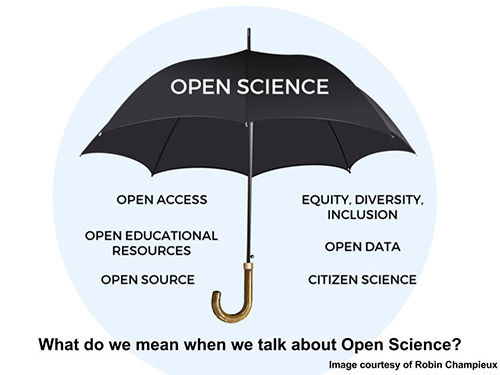
by Robin Champieux (CC BY 4.0)
  • Note: Research can be reproducible but not open
  • This course: Focus on better transparency and more effective collaboration through version control

Two main challenges for reproducible scientific workflows

Computational Environments

FAIR and reproducible training materials are beneficial to you!

  • Information sheets saves time in sharing information
  • Clear communication
  • Saves time in on-boarding / reusing materials
  • Preserved & Findable
  • Easy to share within and outside your team
  • Provides you and collaborators with credit (visibility, DOI, citations)

Footnotes

  1. The Turing Way Community (2022), see “Guide on Reproducible Research”

  2. The Turing Way Community (2022), see “Guide on Reproducible Research”

  3. for example, in Psychology: Crüwell et al. (2023); Hardwicke et al. (2021); Obels et al. (2020); Wicherts et al. (2006)

  4. see Baker (2016), Nature

  5. see e.g., Poldrack (2019)

  6. (Source: Wikipedia)

  7. pull requests on GitHub, merge requests on GitLab