Entorhinal cortex signals dimensions of past experience that can be generalised in a novel environment
Journal of Neuroscience

Abstract
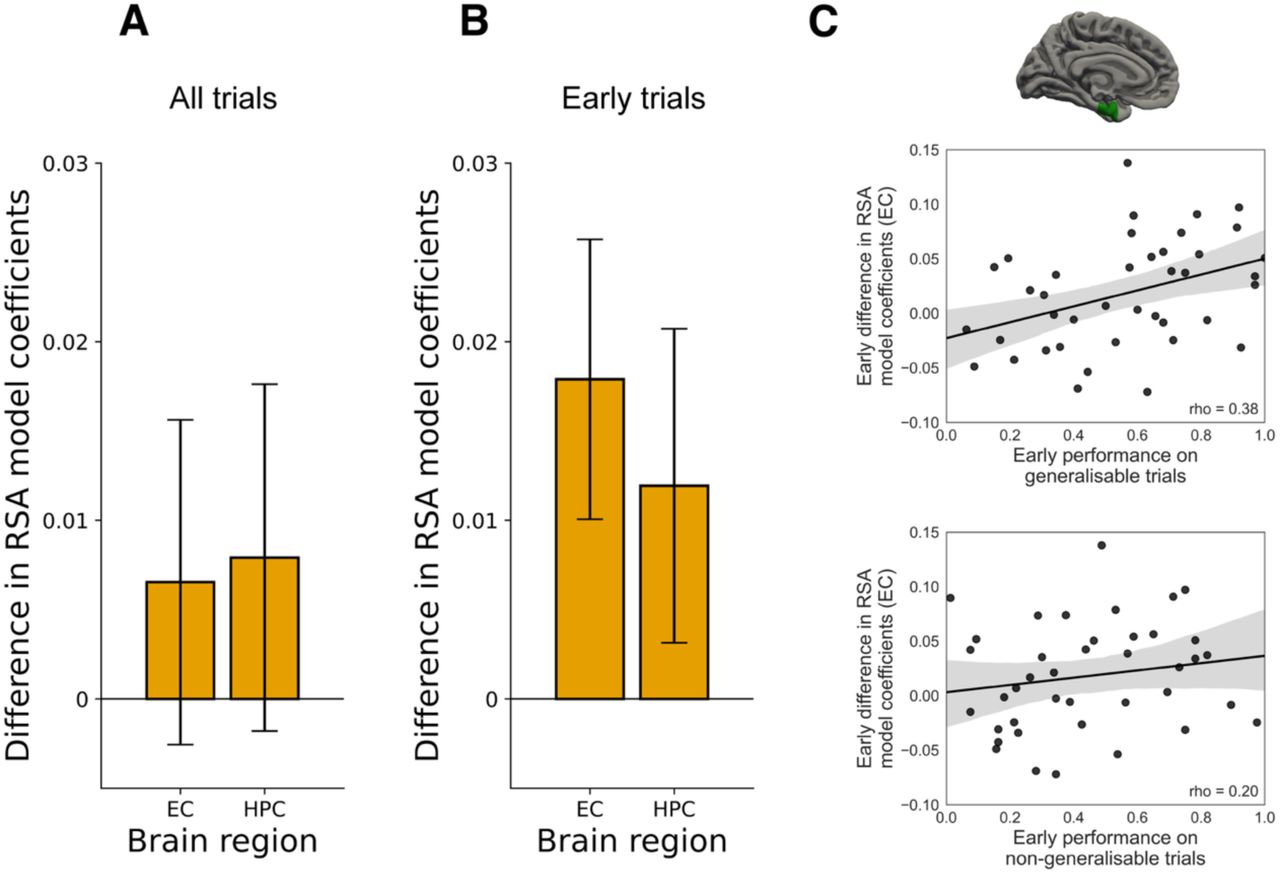
No two situations are identical. They can be similar in some aspects but different in others. This poses a key challenge when attempting to generalize our experience from one situation to another. How do we distinguish the aspects that transfer across situations from those that do not? One hypothesis is that the entorhinal cortex (EC) meets this challenge by forming factorized representations that allow for increased neural similarity between events that share generalizable features. We tested this hypothesis using functional magnetic resonance imaging. Female and male participants (n = 40) were trained to report behavioral sequences based on an underlying graph structure. Participants then made decisions in a new environment where some but not all graph transitions from the previous structure could be generalized. Behavioral results showed that participants distinguished the generalizable transition information. Accuracy was significantly higher in blocks where sequence transitions were shared across environments than those in which transitions differed. This boost in accuracy was especially pronounced during early exposure to the novel environment. Throughout this early phase, neural patterns in EC showed a corresponding differentiation of the generalizable aspects. Neural patterns representing starting locations in familiar and novel environments were significantly more similar in EC on trials where sequences could be generalized from prior experience, compared to trials with new sequential transitions. This signaling was associated with improved performance when prior sequence knowledge could be reused. Our results suggest that during early exposure to novel environments, EC may signal dimensions of past experience that can be generalized.