Challenges in Replay Detection by TDLM in Post-Encoding Resting State
eLife

eLife Assessment
“This study presents valuable findings on the ability of a state-of-the-art method, Temporally Delayed Linear Modelling (TDLM), to detect the replay of sequences in human memory. The investigation provides compelling evidence that TDLM has significant limitations in its sensitivity to detect replay in extended (minutes-long) rest periods. The work will be of strong interest to researchers investigating memory reactivation in humans, especially using iEEG, MEG, and EEG.”
Abstract
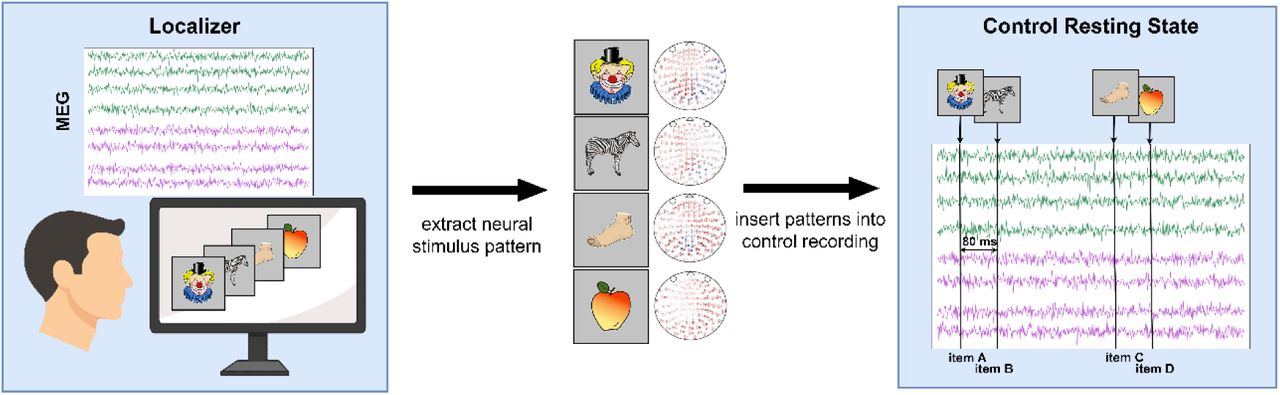
Using temporally delayed linear modelling (TDLM) and magnetoencephalography (MEG), we investigated whether items associated with an underlying graph structure are replayed during a post-learning resting state. In these same data, we previously provided evidence for replay during on-line (non-rest) memory retrieval. Despite successful decoding of brain activity during a localizer task, and contrary to predictions, we found no evidence for replay during a post-learning resting state. To better understand this, we performed a hybrid simulation analysis in which we inserted synthetic replay events into a control resting state recorded prior to the actual experiment. This simulation revealed that replay detection using our current pipeline requires an extremely high replay density to reach significance (>1 replay sequence per second, with “replay” defined as a sequence of reactivations within a certain time lag). Furthermore, when scaling the number of replay events with a behavioural measure, we were unable to induce a strong correlation between sequenceness and this measure. We infer that even if replay was present at plausible rates in our resting state dataset, we would lack statistical power to detect it with TDLM. Finally, contrasting our novel hybrid simulation to existing purely synthetic simulations indicated that the latter approaches overestimate the sensitivity of TDLM. We discuss approaches that might optimize the analytic methodology, including identifying boundary conditions under which TDLM can be expected to detect replay. We conclude that solving these methodological constraints will be crucial for optimizing the non-invasive measurement of human replay using MEG.